
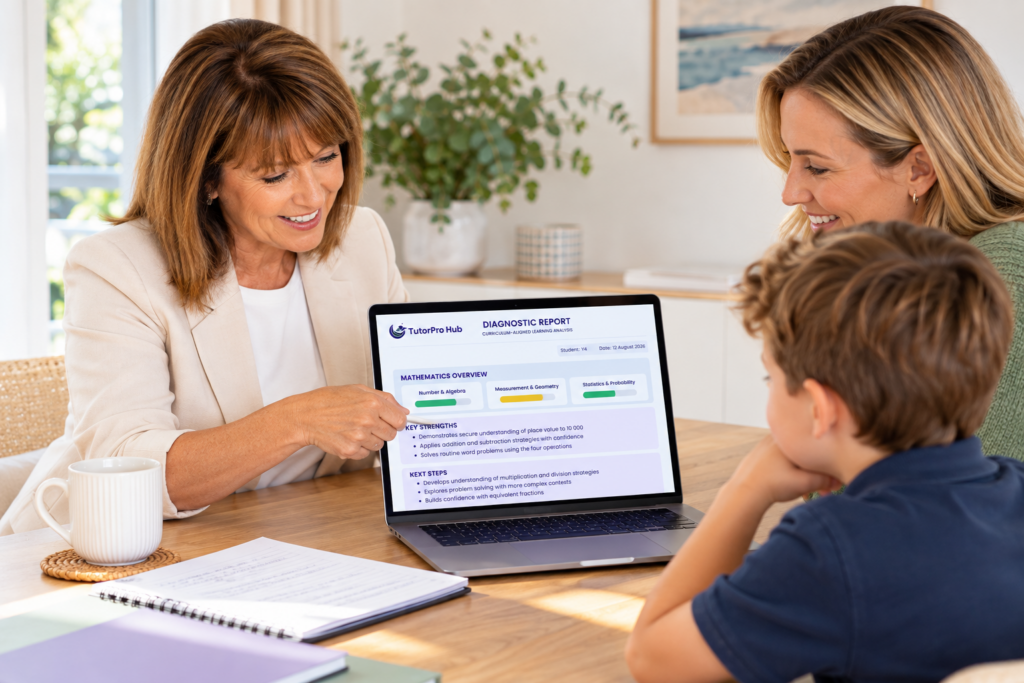
“What did you do in the lesson today? What did you learn?”
These are questions many parents ask their child following their tutoring session. They can also be difficult for a student to answer. Students tend to describe the activity rather than the learning behind it, so parents may hear replies such as:
- “I did worksheets.”
- “I didn’t learn anything new.”
- “I don’t know what I learned.”
Replies like these do not necessarily mean that a lesson lacked value. Students are rarely equipped to answer a parent’s question accurately. Few will say, “We focused on equivalent fractions today, and I learned about numerators, denominators and calculating the highest common factor.” Breaking a lesson down into concepts and skills is a demanding task, and it is not one that students are usually asked to do. A student may also not recognise new learning when a skill is being consolidated or extended step by step.
Even so, for a tutor who has carefully identified a learning gap, referenced the relevant curriculum, chosen a teaching focus and planned the session with purpose, these replies can feel discouraging. For a parent, their child’s feedback may be the only information they receive about the sessions they are paying for. If parents cannot see that their child’s understandings are advancing, they may begin to wonder whether their child’s tutoring is worthwhile. Some families may decide to stop tutoring, even when a student is making steady progress.
Many of us who run tutoring businesses think of student retention as a matter of business administration, and that is understandable. In my own practice, we did not consciously develop strategies specifically to retain students. As well as prioritising individualised learning and developing positive relationships, we also focused on making learning and progress visible to students and their parents. Once a student commenced having tutoring with us, 98% of them continued with us until they completed Year 12. In my experience, making a child’s academic progress visible to their parents and students re-enrolling for tutoring year after year are closely connected.
Why academic progress can be difficult to observe
Several factors can make weekly progress less obvious for parents to see:
- Students describe tasks, not skills. “Worksheets” can mean anything from revising a basic concept to applying newly learned concepts to an unfamiliar context.
- Learning is not always noticed. When a skill is being consolidated, it can feel familiar to a student, who may then say they did not learn anything new.
- The planning is out of sight. Following up on each lesson and preparing for the next one takes place outside the tutoring session. This includes identifying gaps, matching them to the curriculum and deciding what to teach next. It is not obvious to a parent or a student that lesson preparation and follow up is happening.
- Curriculum language is unfamiliar. Terms such as content descriptions and achievement standards are familiar to teachers, but not necessarily to parents.
- Updates are often informal. A conversation at the end of a lesson or a short message may not show how a student is progressing over time.
What parents really want to know
“What did you do in the lesson today? What did you learn?” often indicates that parents really want to know:
- Where is my child now, compared with what is expected for their year level?
- What are they working on, and why?
- Is tutoring helping? How do I know?
When parents are informed of the understandings their child is demonstrating and those that are still developing, receive an individualised, curriculum-aligned learning plan and regular progress reports, these questions are answered clearly and early. These actions also make a student’s learning growth visible, which is the most valuable feedback parents can receive.They then have an accurate record of their child’s learning and progress, and do not need to rely on a student’s brief summary of a session.
Beginning with a diagnostic starting point
One way to answer these questions early is to begin with a diagnostic view of the student’s current understanding, and to share a learning plan with parents. A plan of this kind may include:
- the student’s starting point, referenced to the Australian Curriculum
- the specific understandings and learning gaps that have been identified
- specific overarching learning goals
- the teaching focuses for the coming weeks,
- how learning progress will be shown
With this in place, answers such as “we did worksheets” have context. The worksheets are part of a plan the parents have already seen, and the tutor can reference the focus that each session supports. Later progress reports can be used to monitor and communicate academic growth, informing parents so they can see movement over time.
Parents who can see a clear purpose and steady progress towards set learning goals are more likely to continue tutoring for as long as it benefits their child. This supports student retention.
Supporting Visible Progress and Student Retention with TutorPro Hub
Providing families with regular, curriculum-referenced feedback takes considerable time when it is done manually. TutorPro Hub is designed to automate much of the curriculum-mapping workflow behind that feedback, so that tutors can share clear evidence of learning and progress without lengthy preparation. Tutors upload a student’s work sample, writing test or mathematics assessment, and the platform:
- reviews the work against the relevant Australian Curriculum content descriptions
- interprets the student’s demonstrated understanding using the curriculum codes and achievement standards
- identifies the understandings the student is demonstrating and those that are still developing
- pinpoints specific learning gaps and suggests next steps
- generates an individualised, curriculum-aligned learning plan with clear teaching focuses
- produces a professionally presented progress report for you to review, personalise and share with parents.
Together, these outputs allow a tutor to show parents where their child’s tutoring journey began, what is being worked on and why, and how the student’s understanding is developing over time. This is the information parents are looking for when they ask what their child is learning in tutoring lessons.
Visible Progress and Re-enrolment
Making progress visible to parents can go a long way toward supporting student re-enrolment and retention. In my previous tutoring business, this is what we observed: parents were more likely to re-enrol their children when they could see what their child had achieved and what they would benefit from learning next.
Even when a student achieves their initial learning goals, continually updating their learning plan and setting new goals helps parents see the next stage of their child’s learning. Learning is continuous, and the curriculum builds from year to year, so there are always further goals to work towards, whether that means extending understanding within a year level or preparing for the next.
When a parent asks, “What did you do in the lesson today? What did you learn?”, the best answer is supported by a learning plan, regular progress reports and clear next goals. In my experience, visible progress is often one of the most important reasons parents choose to continue having their child tutored.
TutorPro Hub is designed to support making student progress visible: from the initial diagnostic and learning plan, to regular progress reports, and then to updated plans and new learning goals as a student’s understandings, knowledge and skills develop.
Join our early access community
TutorPro Hub is currently in its pre-launch phase, and we would be pleased to welcome you to our early access community.
By joining our early access email list, you will be notified when the platform goes live and will be among the first to hear about our upcoming Founding Member discounts.
To join, please enter your email address in the early access form on this page.